


Sustainable innovation in wastewater
treatment and residue valorization
LabICAB develops advanced technologies to enhance wastewater treatment and convert agro-industrial residues into bio-based molecules and energy, promoting circular economy and resource efficiency.
We research and develop technologies to optimise the efficiency of wastewater treatments and to convert residues from waste, wastewater treatment plants and agricultural operations into high-value bio-based molecules and energy, offering sustainable alternatives to their counterparts traditionally derived from fossil or food-grade materials.
As such, our work contributes to the valorization of residual biomasses within the concept of biorefineries, improving resource use efficiency, closing material loops, minimizing environmental impact and advancing the circular economy in these sectors.
We support the transition towards more sustainable industrial ecosystems by fostering innovation at the intersection of environmental engineering and biotechnology.
Waste to value – LabICAB’s integrated research lines
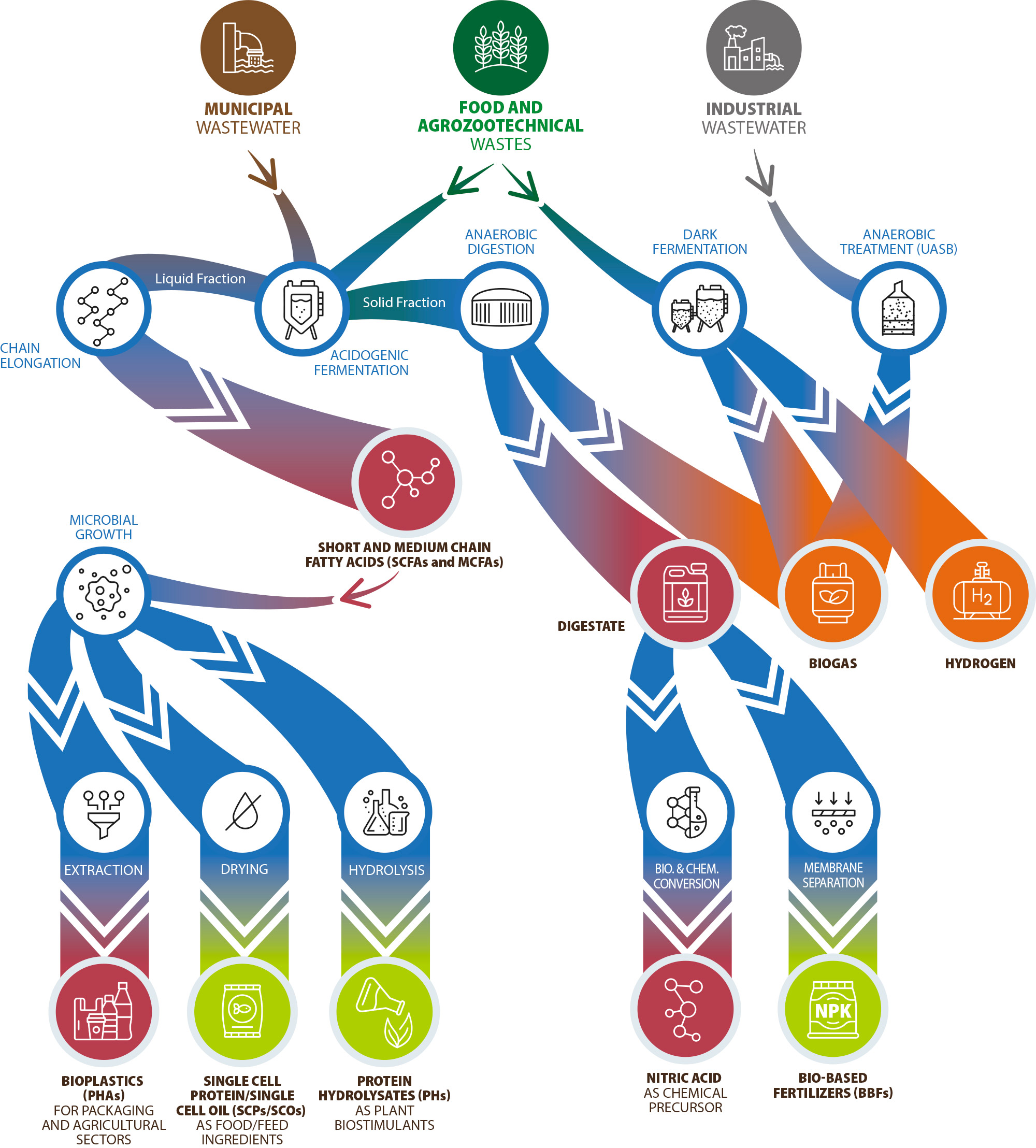
Our research areas are product-oriented,
with a specific focus on:
WASTEWATER TREATMENT
We design innovative strategies for resource recovery in wastewater treatment, while ensuring safe and reliable effluent discharge.
Collaborating with utilities and industrial partners, we develop technological solutions to enhance treatment efficiency, cut operational costs, minimize energy use, and lower greenhouse gas emissions. Our investigations target the optimization of anaerobic reactor performance and the conversion of recovered cellulose fibers from municipal wastewater into valuable products.
CHEMICALS
We develop cost-efficient technologies to produce, separate, and purify bio-based chemicals from organic residues, mainly from agricultural activities, food processing, and wastewater treatment plants.
Our research focuses on recovering fatty acids (short- or medium-chain) from organic residues by optimizing production and extraction processes. We are also advancing the production of bioplastics (PHAs) from sewage sludge and agro-food residues, scaling up to pilot and commercial applications. Additionally, we have developed a novel process to recover bio-based nitric acid from ammonia in agricultural digestate, aiming to integrate this technology with biogas plants.
BIOFUELS
We investigate the bioconversion of agro-zootechnical residues to into renewable energy such as biogas and hydrogen.
Our studies examine key operational parameters – including temperature, organic loading rate, pH, and hydraulic retention time – to optimise the anaerobic digestion process. A particular focus is placed on two-stage anaerobic digestion, which can increase the yield of biogas and hydrogen while reducing CO2 emissions. By refining this process, we aim to upgrade existing biogas plants, improving their efficiency and sustainability, and advancing a circular, eco-friendly energy system.
NUTRIENT RECOVERY
We design and implement technologies to recover nutrients from organic residues, reducing reliance on synthetic fertilisers and mitigating agriculture environmental impacts.
Our research prioritizes cost-efficient membrane-based methods to extract nitrogen, phosphorus, and potassium from anaerobic digestate. We also produce microbial proteins from agri-food residues that can be used directly as feed ingredients or further processed to obtain protein hydrolysates with plant biostimulants effects. This approach aims to enhance the sustainability of agriculture through innovative nutrient recovery and utilisation processes.